AI Security
Machine learning for security and privacy since 2017, spanning private learning, behavioral authentication, IoT and ransomware detection, side-channel inference, and adversarial malware analysis.
My work on machine learning and security began in 2017, well before the recent focus on large language models. It covers three connected questions: how learning can detect security threats, how sensitive information can be inferred through learned models, and how to protect models and the data they use. The methods range from linear regression and statistical sequence models to CNNs, LSTMs, and vision transformers.
Privacy-preserving learning and collaboration
SM-DDP (IEEE PAC 2017) combines secure multiparty computation and differential privacy for linear regression. We implemented the protocol with HElib and evaluated it on census data and a multi-institution healthcare dataset, enabling analysis while protecting participants’ inputs and limiting information disclosed by the result.
Curie (CODASPY 2019) adds policy-governed data exchange to collaborative analysis. Partners specify who may receive which data and under what conditions; negotiated policies govern the secure computation. A healthcare application evaluates the interaction between sharing policies, privacy, and predictive utility. Our homomorphic encryption survey provides the broader cryptographic background for computing on protected data.
Behavioral user authentication
WACA uses smartwatch motion during typing to build behavioral profiles and continuously verify the user. Its learning pipeline includes sensor preprocessing, feature extraction, user-specific profiling, and classification. The initial IEEE SPW paper and journal study examine the practical tradeoff between observation time and authentication error.
PACA and PINTA extend the privacy side of behavioral verification through protected template comparison and encrypted profiles. These cryptographic protocols complement the behavioral analysis by protecting its sensitive inputs. More context is on the IoT Security & Privacy project.
Inferring smart-home activities from encrypted traffic
Peek-a-Boo (WiSec 2020) uses a sequence of learned decisions to infer devices, their states, and user activities from wireless traffic metadata. The pipeline combines supervised device and state classification with a hidden Markov model for activity sequences. This demonstrates how ML can turn encrypted-traffic patterns into a privacy threat, and motivates our cover-traffic defense.
Detecting cryptojacking and IoT intrusions
Our IoT cryptojacking detector (NDSS 2022) learns from packet timing and size features. We compare logistic regression, k-nearest neighbors, SVM, and Gaussian Naive Bayes, then evaluate the SVM detector across mining strategies and network conditions. The cryptojacking survey places such detection techniques in the broader attack and defense landscape.
The on-device IoT intrusion-detection study compares logistic regression, k-nearest neighbors, decision trees, random forests, Naive Bayes, and neural networks, measuring the costs of training and inference. TinyML experiments examine deployment on microcontrollers, where energy and latency matter alongside accuracy. Our energy-focused review synthesizes on-device learning approaches and their resource tradeoffs.
Learning activity sequences for forensics
VERITAS (NDSS 2022) learns a first-order Markov model from smart-environment events. It uses device-state transitions to infer activities and investigate anomalies, policy violations, and possible tampering. This is a use of probabilistic sequence learning for security investigation.
ML-based ransomware detection
The RøBguard defense (ACM TWEB 2025) applies machine learning to browser ransomware. It hooks the File System Access API and classifies behavior to identify the ransomware activity studied in our RøB work. The evaluation examines detection effectiveness and runtime overhead. The Web Security project connects this detector to the underlying browser attack surface and complementary defenses.
Adversarial malware detection
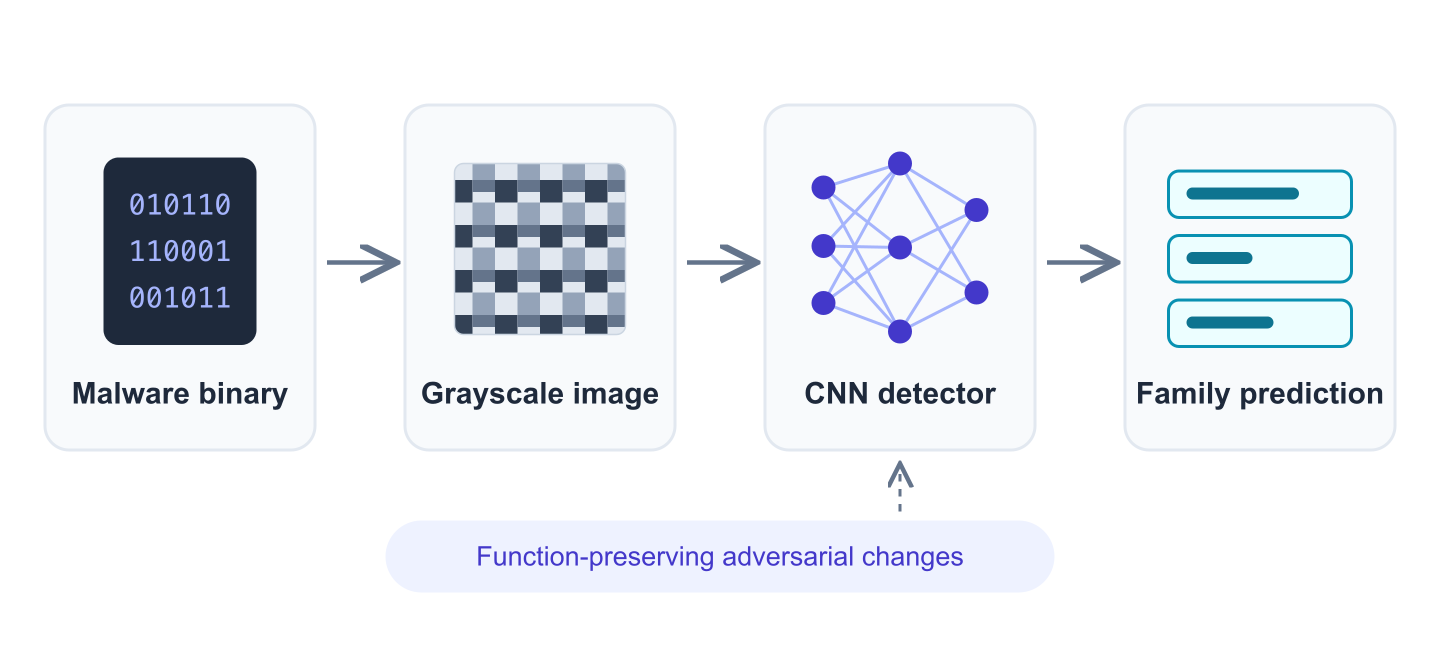
Our image-based malware study evaluates a CNN operating on binary images alongside MalConv under four functionality-preserving attacks. Image-based classification was more resistant to the tested black-box byte-append attacks, but both approaches remained vulnerable to white-box FGSM attacks. The result highlights the importance of evaluating detectors against an attacker who actively changes the input.
Our WiSec 2022 WebAssembly study examines how code obfuscation can cause an existing ML cryptojacking detector to miss malicious samples. The follow-up work on evasive Wasm continues this line of research. The patented WASMGUARD represents Wasm binaries as image-patch sequences and uses a vision transformer to classify malicious code, including obfuscated samples.
Deep learning for VR side-channel inference
IMMERSPY (NDSS 2025) recovers spoken-digit information from motion-sensor vibrations caused by a VR headset’s speakers. A CNN-LSTM processes spectrogram representations of the signal. The work also uses generative text-to-speech to produce training examples without requiring labeled recordings from the victim. It studies both informed and uninformed victim settings and evaluates a tone-based defense. See the Mobile Security project for the wider XR context.

Abbas Acar
Senior Security Researcher
Senior Security Researcher at Geotab. Product, embedded, and AI/ML security.