IoT Security & Privacy
Securing connected devices and smart environments through wearable authentication, smart-home privacy, access control, cryptojacking detection, and forensic analysis.
Project resources
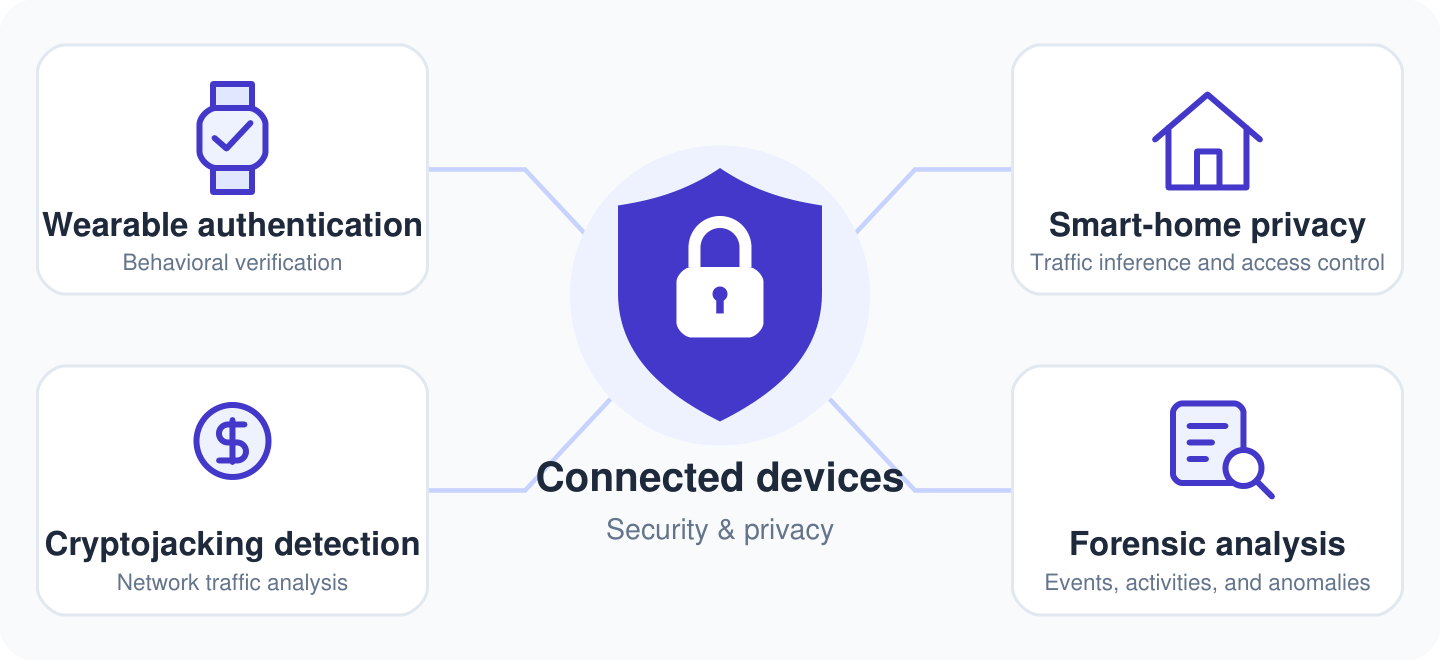
Connected devices bring security decisions into homes, workplaces, and shared physical spaces. Our research examines who can use these devices, what their sensors and communications reveal, and how to detect and investigate abuse. It spans wearables, smart homes, IoT infrastructure, and resource-constrained devices.
Wearable authentication: WACA, PACA, and PINTA
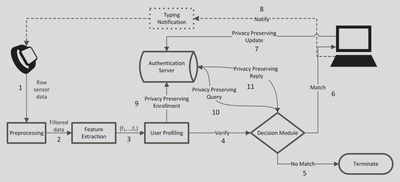
WACA continuously verifies the person using a computer from smartwatch motion sensors while they type. The IEEE SPW study and IEEE TMC article develop the sensor-processing, feature-extraction, user-profiling, and classification pipeline. This brings behavioral verification beyond a single login check. The work also led to a continuous-authentication patent.
The related protocols protect the behavioral information used for verification. PACA combines password-authenticated key exchange with private biometric template matching. PINTA combines a password with host and network behavioral profiles, using fuzzy hashing and fully homomorphic encryption to protect those profiles.
WACA funding
The WACA effort was supported by approximately $500,000 in combined NSF SaTC funding, through awards #1718116 to FIU and #1718109 to Florida Atlantic University. Demos and team details are on the WACA project website.
Smart-home privacy and access control
Peek-a-Boo (WiSec 2020) shows how encrypted wireless traffic can reveal device states and household activities. A cascading ML pipeline identifies devices and states, then models activity sequences, using traffic from Wi-Fi, ZigBee, and BLE devices. We also evaluate a defense that generates cover traffic to obscure device behavior.
Kratos (WiSec 2020) addresses homes where several people share several devices. Its policy manager negotiates conflicting access requests and restrictions, supporting more expressive control than a single-owner model. We implemented and evaluated it in real smart-home deployments.
Our later studies examine access control and authentication in shared IoT devices and privacy perceptions across race and ethnicity, adding the perspectives of the people who use these systems.
IoT cryptojacking and infrastructure abuse
Our NDSS 2022 cryptojacking detector uses network-traffic features to identify unauthorized mining across heterogeneous smart-home devices. We compare supervised classifiers and evaluate an SVM-based detector under aggressive and stealthy mining, different device platforms, and partially or fully compromised networks. These experiments test how attacker behavior and deployment conditions affect detection.
The broader cryptojacking systematization organizes attacks and defenses. Our Docker honeypot study examines related infrastructure abuse through forensic observations of host-resource usage and network traffic.
Smart-environment forensics
VERITAS (NDSS 2022) reconstructs activities and suspicious behavior from smart-environment event logs. A first-order Markov model captures transitions between device states to support forensic inference, including policy violations and signs of tampering. The evaluation uses 22 commercial devices and more than 84,000 incidents.
On-device machine learning for intrusion detection
Our IoT intrusion-detection study compares ML training across cloud, edge, and device platforms, and evaluates TinyML inference on microcontrollers. It measures energy, execution time, and detection performance to understand the cost of keeping analysis close to the device. A companion review of on-device ML surveys energy-aware training and inference, including distributed and federated approaches.
Identity and other connected systems
EVOKE supports efficient revocation of verifiable credentials in constrained IoT networks. Our decentralized-identity survey covers the wider identifier and credential ecosystem.
Related work includes IoT-enabled smart lighting, a security and performance assessment of UAV authentication, and jamming and hijacking attacks on micro aerial drones.

Abbas Acar
Senior Security Researcher
Senior Security Researcher at Geotab. Product, embedded, and AI/ML security.